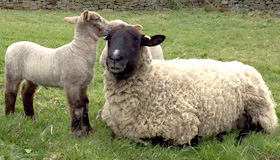
It's been a very busy few months, but Lambing 2020 has begun!
Delighted with our ewes who have produced a beautiful batch of Suffolk/Suffolk cross lambs.
I have been asked to tell you a little more about lambing.....so here goes!
The ewes are brought inside a week before their lambing time so that they can get used to the new surroundings and new food. Being kept inside means that they do not graze grass, but eat hay (grass that was cut in the summer, dried and the made into bales) which their stomachs need to get used to. They are also fed extra specialist sheep food before and after lambing to help the lambs develop, produce milk and not put too much strain on the ewes.
Once inside, I get them into a routine quickly so that it is normal for me to be around them in close proximity. Our sheep are quite tame, but there is still an element of uncertainty when close to a human and I like them to be calm and comfortable having me around. As, when the times comes, they may need my assistance and I like them to be happy to have me there. Some of my ewes, just like me in the corner next to them. I offer words of encouragement and hopefully a 'calmness' to help them through it. I'm not sure if they understand me.....but it helps me!
Checks are done throughout the day and night,and after tea-time feeds the night-shift begins. Everyone has their own way of doing this, but I check mine every 3 hours so at 21:00, 24:00, 03:00 and the day starts at 06:00.
I put on as many clothes as I can, quietly get out of my caravan and toddle around with my headtorch on speaking softy so as not to startle anyone. Ewes do little things which give indications that she may be going into labour. Some of these are: not eating; finding a quiet corner; digging at the ground and making a nest; curling her upper lip etc. These are what I'm looking for, and if I startle her she may stop doing it and then I may miss the start of labour. If a ewe is doing these things, I'll sit quietly nearby and watch to see what happens.Some ewes do these things days before they actually start full labour, so patients is key. I can sit there for an hour or so and her not progress, so I'll pop back to my caravan and see if I can get an hours' sleep before I go back out to her.
If it's the start of labour, I'll make myself a coffee (time to wake up), then get my 'lambing box' out ready. This is full of lots of things just in case the ewe or the lamb needs assistance. Labour can take anything from 3 - 6 hours depending upon what stage she is at, and if she is a first time mum. Hopefully it's over quickly and smoothly for ewe and lambs/s. It's my job to watch and make sure everyone gets through it safely. If I think the ewe is struggling I will help her out. A lamb should come out head first with both front feet either side of its head. There are a few things that could mean that I need to help: the lamb maybe a big; one leg back, 2 legs back, coming backwards (breach).
Once born the ewe should get up and lick the lamb all over. This is to clean and dry it, but also this forms an important bond between the two of them and is an exceptionally important part of the birth. If this doesn't happen there can be problems later with rejection. The next important part is the lamb sucks from it's mother. She is full of colostrum at this stage, which is very thick, sticky milk full of antibodies and energy for the lamb. There may be another lamb (or a few more), and the same must happen with all the lambs.
So that's a quick description of lambing, hope you enjoyed it? It's exceptionally emotional and very tiring.....but then isn't everything that's worth doing?